Russia cancels tank display at Victory Day for first time in 19 years
Russia held its annual Victory Day parade on Red Square without tanks or missiles for the first time in 19 years, citing security threats from Ukraine.
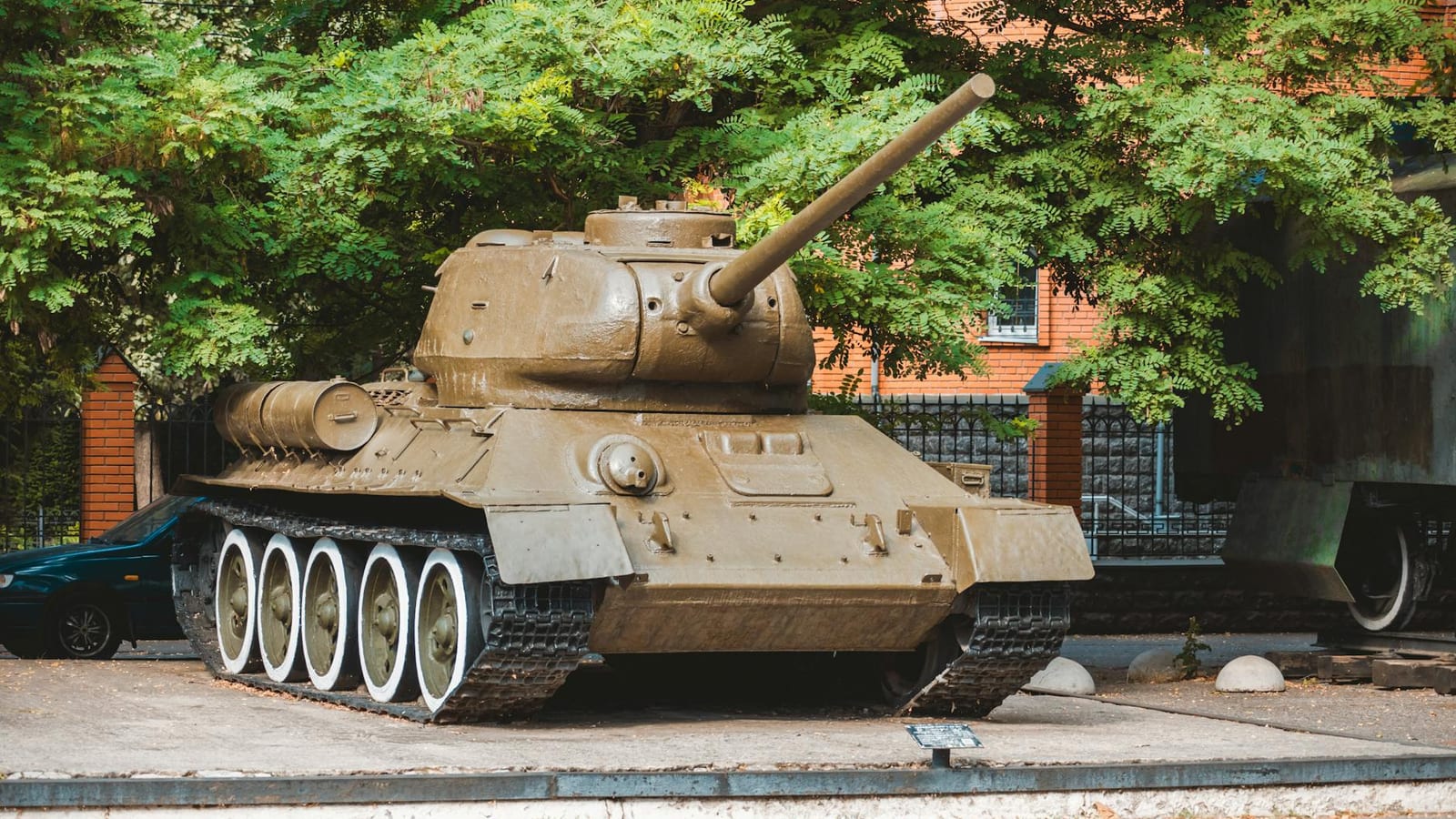
Red Square, Moscow, May 9. Hundreds of paratroopers march in formation, the banners are up, and Vladimir Putin has just finished speaking. Then something unexpected happens: nothing. No tanks roll. No intercontinental missile carriers rumble across the cobblestones. A large screen flickers instead, showing footage of soldiers in trenches and a tank charging to their aid.
For the first time in 19 years, Russia cancelled the military hardware display at its Victory Day parade. The Kremlin called it a security precaution. The world saw something else.
Russia’s Defense Ministry had announced about two weeks before the event that there would be no military equipment on Red Square this year, citing the “current operational situation” in Ukraine. Kremlin spokesman Dmitry Peskov called it a “terrorist threat” from Ukrainian forces. Security forces blocked mobile internet across Moscow on the day. Checkpoints were dense, barriers stretched for blocks.
The reason is not hard to read. Russia has been fighting in Ukraine for over three years. The modern tanks and missile launchers that normally feature in the parade are either at the front, destroyed in battle, or held back for operational use. Displaying them on a ceremonial occasion is neither logistically convenient nor militarily wise right now.
Parades are political theater. When the theater goes dark, it tells you something about the state of the play.
Putin used his speech to draw the same connection he has been drawing since the war began: between the Soviet victory over Nazi Germany in 1945 and Russia’s current invasion of Ukraine. He told the crowd that the Soviet people had “saved the world” from “total, merciless evil.” He welcomed veterans alongside participants of the “special military operation,” Russia’s official term for the war. He said the legacy of the “victorious generation” of 1945 was inspiring Russian soldiers carrying out “special operations” today.
He did not say “Ukraine” once. Instead, he described an abstract “aggressive force” armed and supported by NATO, against which Russian “heroes” were standing firm. “I am firmly convinced that our cause is just,” he said. “We stand together. Victory was and will always be ours.”
This framing is deliberate. Whether it convinces Russians or simply justifies the ongoing cost of the war is harder to know from the outside.
The guest list told its own story. Last year, Chinese President Xi Jinping stood on the grandstand next to Putin as the guest of honour. This year, he did not come. Russia and China have cultivated a strategic partnership built around a shared interest in countering American-led global order. Xi’s presence in 2025 was a public signal. His absence in 2026 is also a signal, though a quieter one. Beijing appears to be managing the optics of its association with Moscow more carefully.
The only European Union leader present was Robert Fico, the Slovak Prime Minister, attending for the second consecutive year. He did not watch the parade but laid a wreath at the Tomb of the Unknown Soldier near the Kremlin wall. Central Asian leaders came, as they usually do. The broader international crowd that once gave these ceremonies a semblance of global legitimacy has largely stopped showing up.
Then came the Trump element.
On the Friday before the parade, US President Donald Trump announced that he had convinced both Russia and Ukraine to observe a three-day ceasefire over the Victory Day period, running until Monday. The Kremlin moved quickly to embrace this framing. Putin’s foreign policy advisor Yuri Ushakov said Russia welcomed the initiative and noted that Putin had reminded Trump, in a recent conversation, that the United States and Russia were allies during the Second World War.
That detail is strategically placed. Putin invoking the wartime US-Russia alliance suggests a possible off-ramp narrative: we were partners once, we could be again. The implicit pitch to Trump is obvious. When a journalist asked Peskov after the parade whether the ceasefire could be extended, as Trump had hoped, he sidestepped the question. The agreement held until Monday. No further discussions had occurred.
For India, this stripped-down parade carries specific implications worth thinking through.
New Delhi has maintained a careful position on the Russia-Ukraine war, continuing to import discounted Russian crude oil, abstaining on UN resolutions condemning the invasion, and keeping diplomatic channels open with Moscow even as Western governments applied pressure for a sharper stance. That balancing act has served India reasonably well so far.
But the diminished parade reveals something useful: Russia’s capacity to project power is visibly shrinking. A country that scraps its most symbolically loaded military display and replaces it with a video screen is under more strain than it publicly acknowledges. India’s defense relationship with Russia, which spans decades and covers a significant portion of the armed forces’ equipment inventory, now carries a longer-term question: how reliable is a supplier whose domestic arms industry is stretched by active, grinding warfare?
Xi’s absence adds another layer. India has long managed a delicate triangular dynamic with Russia and China, aware that a tight Russia-China alignment complicates its own strategic space. If Beijing is recalibrating its public closeness to Moscow, even marginally, the shape of that triangle shifts. The India-China border standoff of recent years makes this worth watching closely.
Any movement toward a negotiated end to the Ukraine war, which Trump’s ceasefire gesture hints at without promising, would ripple outward. Global energy prices, sanctions regimes, and the realignment of military partnerships all follow from a settlement. India stands to benefit from cheaper commodities and reduced geopolitical friction, but the terms of any deal will also determine whether Russian arms supply chains stabilise or deteriorate further.
The ceremony wrapped up in about thirty minutes. Shorter than usual. After it ended, Peskov told reporters that nothing had gone wrong. “Nothing was attempted, everything is fine,” he said.
For the people who had waited along Moscow’s streets to glimpse tanks and missiles, it was an oddly quiet occasion. For governments watching from a distance, the quiet was the message.
Russia is at war, and this year, it finally showed.