Pattaya's Sanctuary of Truth: Built in 1981 and Still Not Finished
The Sanctuary of Truth in Pattaya stands 105 metres tall, carved entirely from teak without a single nail, and remains under construction since 1981.
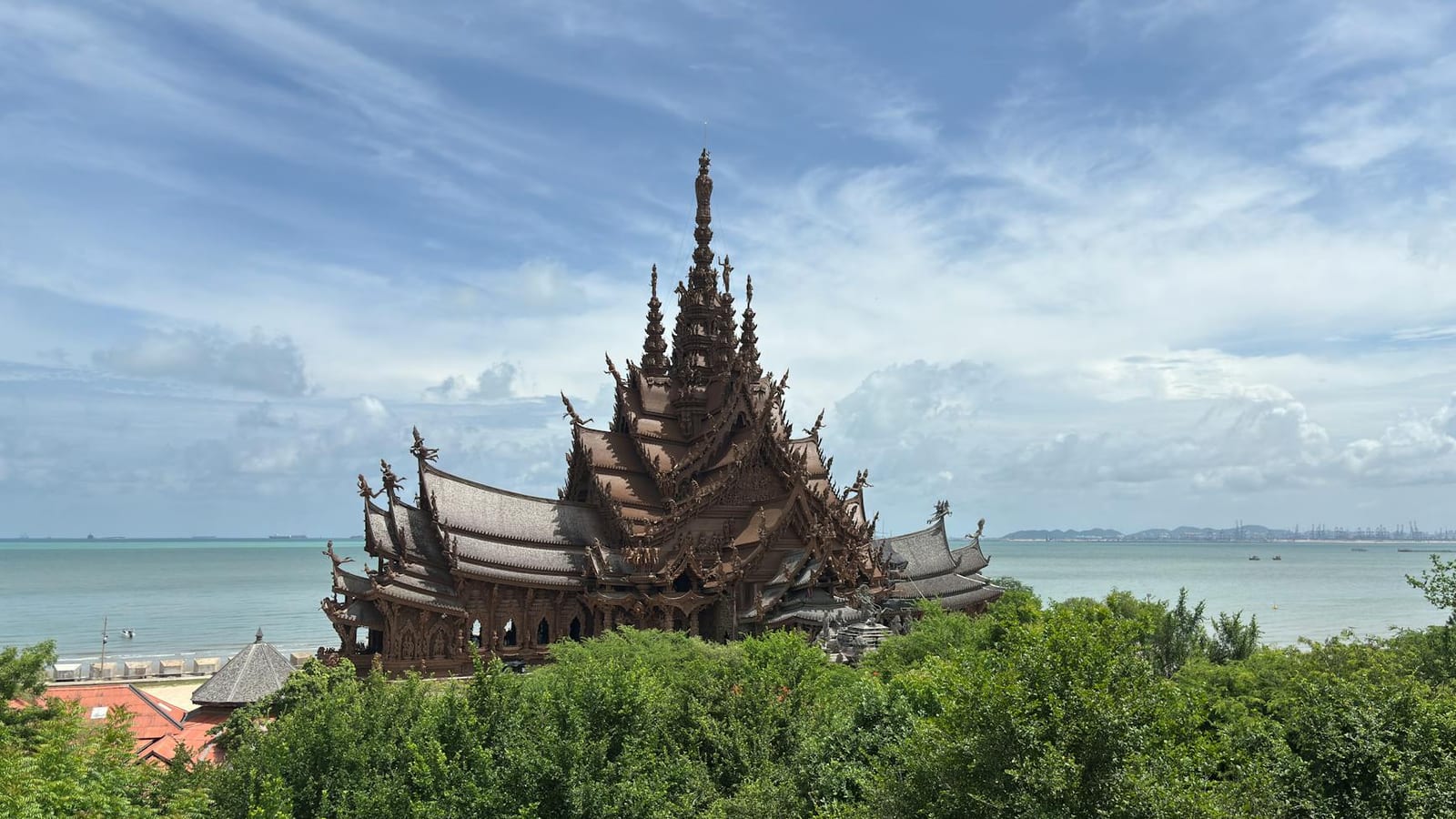
The first thing you see is a wall of wood. Not a door, not a gate. Just an overwhelming mass of carved teak rising from the Pattaya waterfront, somewhere between a temple and a vision. Then you get closer, and the carvings begin to speak.
The Sanctuary of Truth sits at the northern edge of Pattaya, Thailand’s most recognisable beach city, about two and a half hours south of Bangkok by road. The building was started in 1981 by Thai businessman Lek Viriyaphant, who wanted to create a monument to traditional Thai, Khmer, Chinese, and Hindu philosophical thought, all carved in wood, all expressing something about humanity’s relationship with religion, nature, and time. At roughly 105 metres tall, the structure is built using traditional Thai joinery, which means wooden pins, careful interlocking, and gravity do the work that bolts and concrete do in modern construction.
Not a single nail or screw holds it together.
It is also, after more than four decades, still being built. When the current generation of craftsmen completes a section, the oldest portions already need replacing, because exposed wood in coastal Thailand weathers fast. The building will, in some sense, never be finished. That is partly the point.
What you actually see inside
A proper visit takes two to three hours if you walk the perimeter, enter the inner halls, and actually look at what the carvings are showing you. Scenes from the Ramayana sit beside Buddhist cosmological maps. Hindu deities share walls with Khmer mythological figures without apparent contradiction. Brahma and Vishnu appear rendered in Thai style. Garuda serves as a structural support column on one of the outer facades. Kali dances across a wooden beam in a corner most visitors walk past.
For Indian travellers, much of this iconography will feel familiar in unexpected ways. These are stories and figures deeply embedded in South Asian culture, retold here through a Thai artistic lens that is both recognisable and genuinely different. It is not a museum. It is an active philosophical statement, carved by living craftsmen who continue adding to it every day.
Entry costs approximately 500 Thai Baht for foreign adults, which works out to roughly Rs 1,200 at current exchange rates. Dress modestly, as you would for any religious site. From Pattaya city centre, a short tuk-tuk or taxi ride takes you to the waterfront location.
Why Pattaya makes sense for Indian families
Most people who visit Pattaya arrive for the beaches and the nightlife. The Sanctuary of Truth gets fewer tourists than it deserves, partly because it sits away from the main strip, and partly because visitors do not always know what they are looking at when they arrive.
Indian families and couples form a growing part of Pattaya’s visitor base, and the numbers have climbed steadily since Thailand removed visa requirements for Indian passport holders in late 2023. Pattaya offers a combination of budget and mid-range hotels, direct charter options from several Indian cities, and a food scene that includes dozens of Indian restaurants alongside local options. For families wanting an international beach holiday without paying Maldives prices, it is a practical choice.
For those who want to avoid the party atmosphere around Walking Street, the Jomtien Beach area to the south offers quieter resorts and family-friendly properties. Decent three-star options on Jomtien currently sit in the Rs 4,000-6,000 per night range depending on season.
Bangkok earns more time than most people give it
Most flights from India connect through Bangkok, which means many visitors spend at least a day or two in the capital before heading south. Bangkok has become a city that rewards slow, purposeful walking. The Grand Palace and Wat Pho are genuinely worth serious time, not just a photo stop. But the best version of Bangkok is also the city itself, the smell of lemongrass rising from street stalls at eight in the morning, the sound of monks carrying across the Chao Phraya at dawn, the way light hits the river just before sunset.
Thai street food in Bangkok operates at a different register from the restaurant version most Indian visitors have tried elsewhere. For travellers who eat vegetarian, the city accommodates with genuine options. Halal food is widely available in areas like Silom and around the older Charoen Krung neighbourhood near the river.
The journey between Bangkok and Pattaya by bus costs around 130 Thai Baht and takes roughly two and a half hours from the Eastern Bus Terminal at Ekkamai. Hired cars and vans are faster but cost significantly more.
The Southeast Asia picture for Indian travellers
Search data shows rising Indian interest not just in Bangkok and Pattaya but in destinations across the broader Southeast Asian circuit, including Phu Quoc in Vietnam, Chiang Mai in northern Thailand, and Koh Samui on the Gulf Coast. The common thread is value. India’s outbound travel market is growing fast, but most of that growth sits in the middle, in families and couples who want an international experience at a price that does not require a year of planning.
Thailand remains well-positioned to capture that demand. It has the infrastructure, the variety, and the cuisine for travellers at almost every budget. And for those who want something that goes beyond beach time and night markets, the Sanctuary of Truth offers an experience that is difficult to categorise and harder to forget.
The structure will keep being built long after your visit. The craftsmen will arrive in the morning and begin carving the next section. The old wood will be replaced as it weathers. And somewhere in that ongoing, unfinished work is the most honest thing about the place: beauty that does not wait to be complete before it has something worth saying.