Mangalsutra Moves to the Wrist as Urban Women Reclaim Tradition
Indian women are styling the mangalsutra as a wrist bracelet, blending tradition with modern professional life in a quiet but meaningful shift.
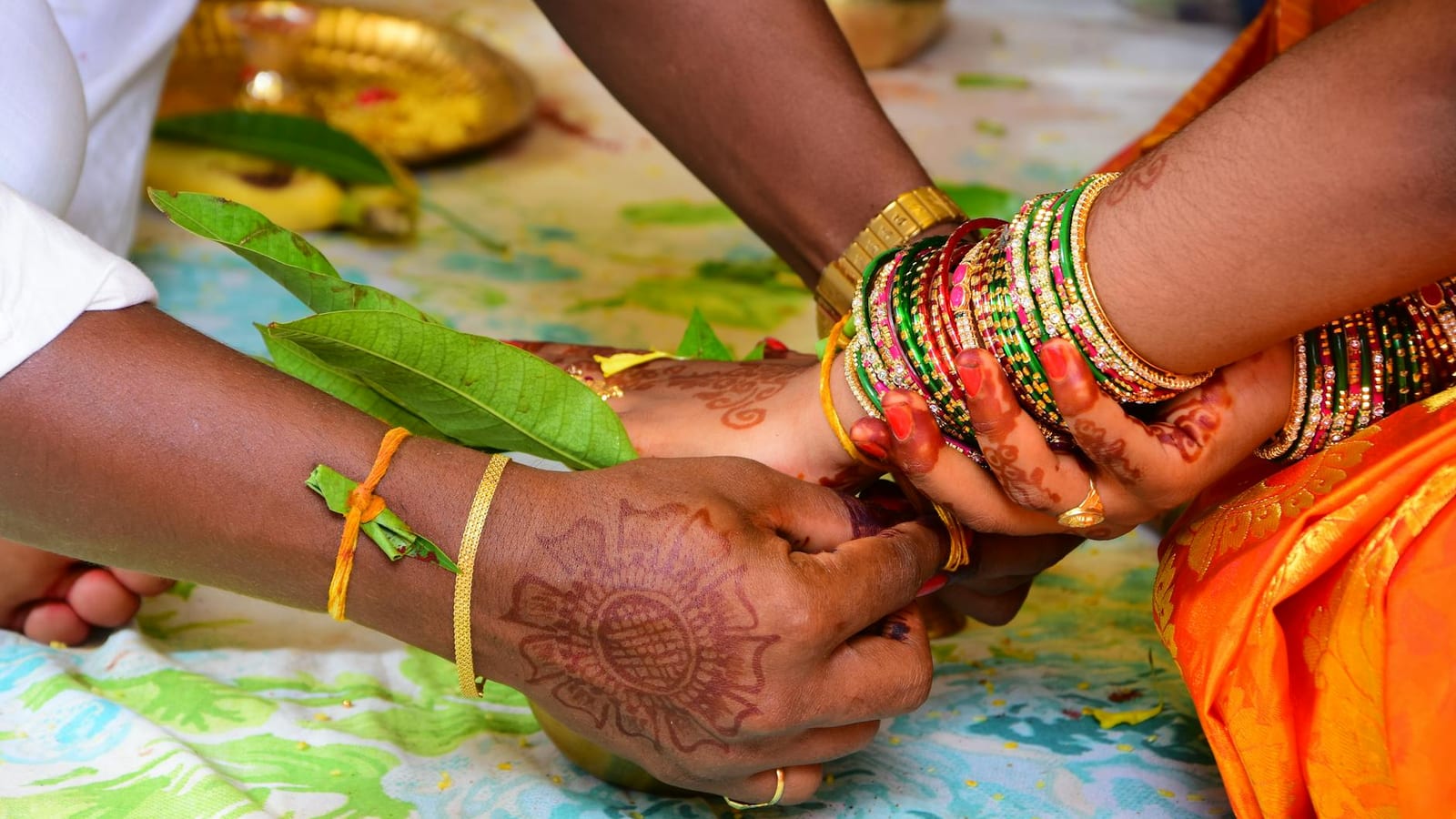
The mangalsutra has spent centuries in the same place. Tied around a woman’s neck on her wedding day, it stayed there, close to the heart, rarely questioned. That positioning is changing now, and the shift is smaller than it sounds but means more than most people expect.
Indian women are increasingly wearing their mangalsutra on the wrist, styled like a bracelet, paired with traditional bangles or worn alone. The designs emerging for wrist-wear mangalsutras feature delicate chains, convertible clasps, and slimmer profiles that sit better on the forearm. Eight distinct wrist-friendly styles are circulating on jewellery platforms right now, ranging from minimalist single-strand black-bead bracelets to heavier gold pieces with contemporary geometric pendants.
This is not a rejection of the mangalsutra. It is a renegotiation of it.
For many urban working women, the neck-length mangalsutra is impractical in a professional setting. A chain that sits at the collar, visible above a blazer or a formal kurta, carries meanings in a boardroom that the wearer may not always want to foreground. Moving it to the wrist keeps the tradition alive while putting it where the wearer controls the visibility, tucked under a full sleeve, or shown off with the casual confidence of a friendship band.
The trend is strongest among women in their late twenties and thirties in metro cities, the generation that grew up watching their mothers wear the mangalsutra as an unmovable given. These women marry on their own terms, negotiate dual incomes, run households collaboratively, and see no reason why their jewellery should not reflect the same flexibility.
What makes the wrist-mangalsutra more than a fashion quirk is the social conversation it opens up. Jewellery in India has always been a form of communication, not just decoration. The maang tikka says bride. The solitaire says arrived. The thick gold jhumkas say tradition-by-choice, not obligation. The mangalsutra on the wrist joins this vocabulary as something new: married-and-modern, traditional-but-not-bound.
The timing connects to a broader pattern. At Met Gala 2026, Isha Ambani appeared in a look that became one of the event’s most discussed Indian fashion moments. She wore a diamond-encrusted blouse, a piece that reworked one of Indian couture’s most traditional silhouettes through an almost architectural lens, and carried a mango in her hand as a deliberate cultural gesture. The mango, India’s national fruit, its most recognisable summer image, showed up at fashion’s most global stage as a calculated statement about where Indian identity stands today: unapologetically itself, but fully comfortable at the world’s table.
Ambani’s look was not about looking Indian for Western approval. It was about asserting Indian aesthetics on Indian terms. The diamond blouse was not explained or softened. The mango needed no caption. That kind of cultural confidence, worn rather than stated, connects a woman at the Met Gala to a young professional in Nagpur choosing to move her mangalsutra from her neck to her wrist.
Both decisions carry the same underlying logic: the meaning matters, the form is mine to decide.
Mother’s Day this year has surfaced another quiet signal. Silver anklets, the payal, have emerged as one of the most popular gift categories for mothers. This is an interesting generational loop. Payal were once something mothers gave to daughters, small silver pieces worn at festivals and weddings, part of the trousseau. Now daughters are gifting them back to their mothers, in designs that are considered and contemporary, some with semi-precious stones, some with modern geometric links alongside traditional ghungroo-style bells.
Seven prominent designs in this year’s Mother’s Day payal category show the range of what is being considered: from delicate single chains with small floral motifs to heavier statement anklets meant to be worn with sarees at family events. The designs span accessible everyday pieces all the way to handcrafted artisan work, reflecting how differently daughters are approaching the idea of gifting their mothers something wearable and meaningful.
The payal as a Mother’s Day gift is partly sentiment. Mothers wore anklets in their youth, often put them away after marriage or in older age. A daughter gifting her mother a payal is in some ways returning something that was set aside, saying that joy in jewellery is not something one outgrows.
But there is also something sharper happening here. Silver jewellery is having a cultural moment in India that goes beyond price points. Gold has always been the serious metal: the investment, the wedding metal, the inheritance stored in small yellow biscuits. Silver was the everyday metal, the functional choice. That hierarchy is softening. Younger consumers are buying silver intentionally, not because they cannot afford gold, but because silver’s cooler tones suit a certain aesthetic, and because silver artisanship in India, particularly from Rajasthan, Odisha, and Karnataka, has always been extraordinary and is finally getting the attention it deserves.
The payal, the mangalsutra bracelet, the diamond blouse at the Met Gala: three separate stories told by the same changing sensibility. Indian women, across income levels and age groups, are making more deliberate choices about how traditional forms appear on their bodies and in their lives. The decision is less about breaking tradition and more about handling it with greater agency.
For the jewellery industry, this shift has practical implications. Brands that have built decades of equity on fixed forms, the mangalsutra that comes in one wearing style, the anklet that is always the same weight and chain, are finding that younger buyers want flexibility built into the design itself. Convertible pieces that can be worn in multiple configurations are increasingly what jewellery designers describe as the fastest-moving category in the mid-premium segment.
The next few festival seasons will reveal whether this is a durable shift or a cycle. But the early signs suggest it is structural. When the way a woman wears her most personal jewellery changes, it usually means something else has changed first, something in how she sees herself, and what she expects the world to see in return.